


Color Control in Manufacturing: Why the Wrong Light Is Costing You Clients — And How to Fix It
- alessandro5941
- Feb 18
- 4 min read
Updated: Feb 24
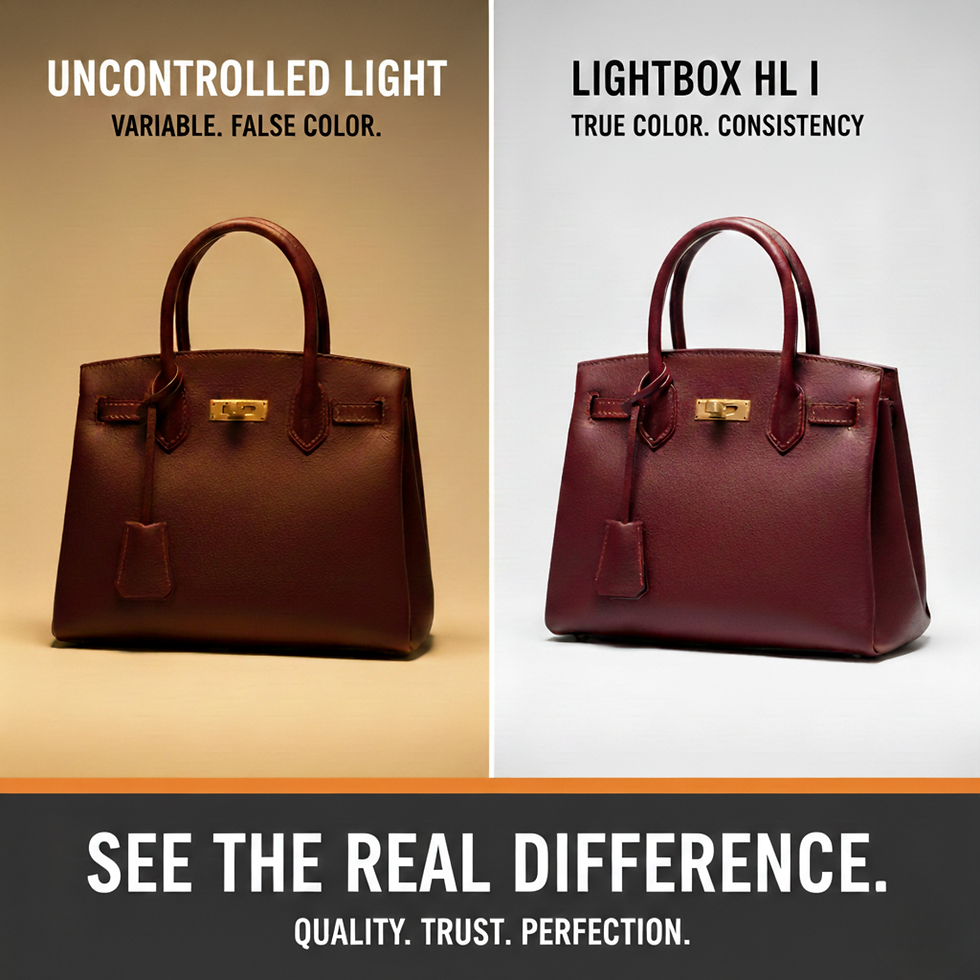
Picture this: your quality control team approves a batch of leather goods. The color looks
exactly right. Everything matches the client's specification. Then the shipment arrives, and the client calls — unhappy. The color isn't what they expected.
This isn't a production problem. It's a lighting problem.
### Color doesn't exist on its own — it only exists as we illuminate it
This is one of the most fundamental principles of colorimetry, and one of the most consistently overlooked in industrial settings. The color we perceive is the result of the interaction between three elements: the object, the light source, and the observer. Change the light, and the perceived color changes. It's the reason why a leather sample that looks burgundy under your warehouse's artificial lighting appears violet in natural daylight.
In industries like fashion, automotive, leather goods, and graphic arts, this phenomenon — known as metamerism — is behind a significant percentage of non-conformities, returns, and client disputes. The cost, often invisible in the P&L, can be enormous.
The solution isn't "check the samples by the window." The solution is always working under the same standardized, measurable, and time-consistent light.
### What a professional light booth actually does
A professional light booth is not simply a box with a white bulb inside. It is an optical measurement instrument that reproduces with precision the illumination conditions defined by international standards.
The ISO standards governing color control are sector-specific: ISO 105 A01 for textiles, ISO 7906 for the leather industry, ISO 3664 for graphic arts and photography, ISO 3668 for paints and coatings. Each standard defines not only the color temperature, but also the spectral distribution of the light, the minimum color rendering index, and the geometric conditions of observation.
A booth that doesn't meet these parameters isn't a control instrument — it's just a light source.
### The Lightbox HL I: what makes it different
The *Lightbox HL I* is a high-precision, profilable illumination instrument developed to eliminate the variables that make color control unreliable in real-world production conditions. It is available both as a traditional light booth and as a hanging luminaire.
*SSL Technology (Solid State Lighting)*
The first departure from traditional booths is technological. The Lightbox HL I relies exclusively on LED sources — no mercury, no fluorescent tubes, no lamps to replace every few months. The sources have a minimum useful life of *15,000 hours* and consume only *66 W* under standard conditions at 1,500 Lux. For a company running the booth 8 hours a day, this translates into years of operation with virtually zero maintenance intervention.
*Real chromatic fidelity, not just a label claim*
The most critical parameter for a professional light booth is chromatic fidelity. The Lightbox HL I has been measured across *100 color samples* according to the TM-30-18 standard — the most comprehensive evaluation method currently available — achieving a fidelity index Rf above *98%*. This means the emitted light matches the theoretical behavior of the Planck radiator at 98%: the physical reference light, not a commercial approximation.
For companies working with brand color standards, Pantone references, or supply chain approved samples, this figure isn't a technical footnote — it's the difference between a correct assessment and a costly mistake.
*Profilability: the real competitive advantage*
Traditional light booths offer a fixed set of illuminants — D65, A, TL84, and not much else. You switch on one light, inspect the sample, move to the next. A rigid process, no customization.
The Lightbox HL I works differently. Its light sources — D65 (6500K, CRI>95), D50 (5000K, CRI>90), UVA (385nm), and profilable RGBW — can each be adjusted independently with 1% intensity resolution, activated simultaneously in any combination, and saved into *up to 10 custom memory configurations*.
This means a company can create and save the exact illumination conditions required by each client, each brand, each supply specification — and recall them in seconds at the start of every inspection session.
*An interface built for daily use*
The system is controlled through a *touchscreen with three-level access software*: user, programming, and maintenance. Line operators work with pre-configured presets without being able to alter core parameters. Quality managers can define new configurations. Specialized technicians have full access to illuminant calibration.
The system connects via WiFi (802.11 b/g/n) to Windows, Linux, Android, iOS, and FreeBSD devices. The control tablet is included with the unit.
*Scalable for large production environments*
One of the less visible but highly relevant features for high-volume inspection environments is the ability to chain multiple units with a *single centralized control*. The Lightbox HL I can be deployed as a standalone desktop booth or as a hanging luminaire, enabling the creation of color control environments of any size with perfectly uniform and synchronized standard lighting.
### Who needs it
If your business operates in any of the following sectors, standardized color control isn't optional — it's a competitive necessity.
*Leather and leather goods:* Color variation between production batches is one of the leading causes of returns and price renegotiations. A calibrated booth compliant with ISO 7906 allows you to document the approval conditions and defend your position in case of disputes.
*Fashion and textiles:* Premium brands increasingly require suppliers to demonstrate they work with certified instruments. Compliance with ISO 105 A01 and the ability to replicate client-side lab conditions precisely is becoming a standard procurement requirement.
*Automotive:* Chromatic tolerances in the automotive sector are among the tightest in any industry. Interiors, plastics, fabrics, and trim components must be evaluated under identical conditions across the entire supply chain.
*Graphic arts and print:* ISO 3664 defines the conditions for proofing evaluation. A compliant booth eliminates ambiguity between print output and digital review.
### The real cost of not having one
The right question isn't how much the Lightbox HL I costs. The right question is: what do returns, rework, disputes, and color-related non-conformities cost your business each year?
For most manufacturing companies, that figure is substantially higher than the cost of a professional instrument. And unlike returns, the instrument generates value over time.
---
*For more information and quotations:*
*Kymera Srl*
📞 +39 0445 192 2315

Comments